
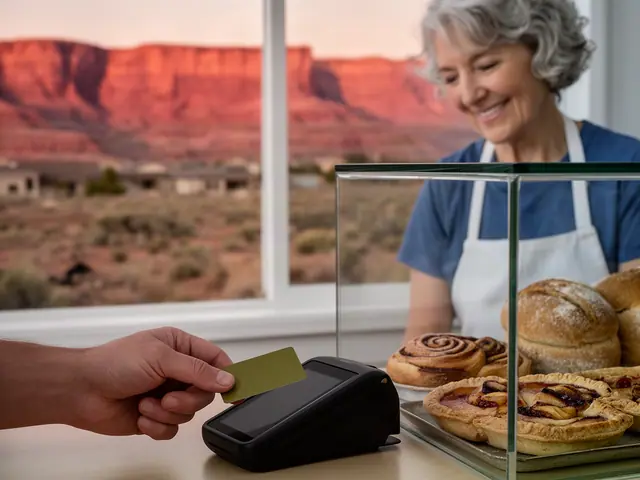
Tealwood Funding Group in St. George, Utah explains merchant cash advances for Washington County businesses: how the purchase of future receivables works, holdback percentages, collections, and how it compares with revenue-based financing and loans.
At a glance
- Retail trade, Washington County, UT
766 employer establishments (CBP 2023)
- Restaurants and other eating places, Washington County, UT
363 employer establishments (CBP 2023)
- Offices of physicians, Washington County, UT
198 employer establishments (CBP 2023)
Revenue-Based Financing vs. a Merchant Cash Advance for St. George, UT Store Owners
Both revenue-based financing and a merchant cash advance rise and fall with sales, yet the contracts behind them differ. Revenue-based financing is usually structured as a loan with payments set as a share of revenue. A merchant cash advance is not a loan: it is a purchase of future receivables at a discount.
For a store owner the practical difference is in the contract: what is owed back in total, how the share is calculated, and what happens if sales fall. Compare the total dollars collected with the interest on a working capital loan or a line of credit for the same amount.
Revenue-based financing can be set against total revenue, including invoices and subscriptions; a merchant cash advance is tied specifically to card receipts. A store with most of its sales on cards fits the advance model; one paid by invoice does not.
Can a Cash Advance Company Sue You? The Default Clause a St. George, UT Shop Reads First
An advance agreement is a contract, and like any contract it says what happens on default: if the business stops depositing card sales, switches processors, or closes. Some agreements include a personal guarantee of performance or a confession-of-judgment clause.
Read the default section before signing, and have your own attorney review it.
Merchant Cash Advance Sales Explained for a Washington County, UT Gym
"Sales" in a merchant cash advance means the card receipts the provider buys. A gym that takes membership dues by card has a steady stream; the provider buys a fixed total of those receipts and collects a set percentage, the holdback, from each day's or week's settlements.
Illustration only, invented figures: a provider advances $40,000 and buys $52,800 of future card receipts (a factor of 1.32). With a 12% holdback on card sales of $3,600 a day, about $432 is collected daily, and the purchased amount is collected in about 123 business days (our arithmetic). In this invented case the gym gives up $12,800 of card sales for the use of $40,000 (our arithmetic).
Because collections follow sales, a slower month stretches the time it takes to collect the purchased amount; the total does not change. Ask whether the agreement allows a reconciliation, where collections are adjusted to actual sales.
What Does Merchant Cash Advance Mean? What St. George, UT Landscaping Crews Ask First
The first question a landscaping crew asks is what it means in plain words: the provider pays you now for part of your future card sales. You do not make a loan payment; the provider takes its agreed share as card sales come in, until it has collected the purchased total.
Crews that bill mostly by invoice or check have few card sales to sell, so an advance can be a poor fit. Equipment financing or a line of credit is worth pricing beside it. See the landscaping page.
Is a Merchant Cash Advance Private Credit for a St. George, UT Auto Repair Shop?
Some merchant cash advance providers are funded by private investors rather than deposits, which is one reason advances are sometimes grouped with private or alternative credit. Legally, though, an advance is structured as a purchase, not a loan, and an auto repair shop should read it that way.
Washington County, UT had 137 auto repair and maintenance employer establishments in 2023 (County Business Patterns). The auto repair page covers lifts, parts and shop buyouts.
What Is a Merchant Cash Advance Company, and What Does It Buy From a St. George, UT Motel?
A merchant cash advance company is the provider that buys the receivables. For a motel, it buys a share of future card payments for rooms. Before agreeing, ask the provider for the purchase price, the total purchased amount, the holdback percentage, any fees, and how collections adjust if occupancy drops.
The hotel page covers renovation and FF&E funding. Other cases: construction, retail, restaurants, and the St. George, UT page has ZIP counts. The comparison page lines up an advance against the five loan types.
Ask, too, whether the provider expects the motel to keep its current card processor, and whether a second advance from another provider is allowed while the first is being collected.
By Tealwood Funding Group · Updated